Save Calhoun County’s Natural Resources
Empowering neighbors to prevent industrial projects that
endanger water, air, land quality, and local wildlife habitats.
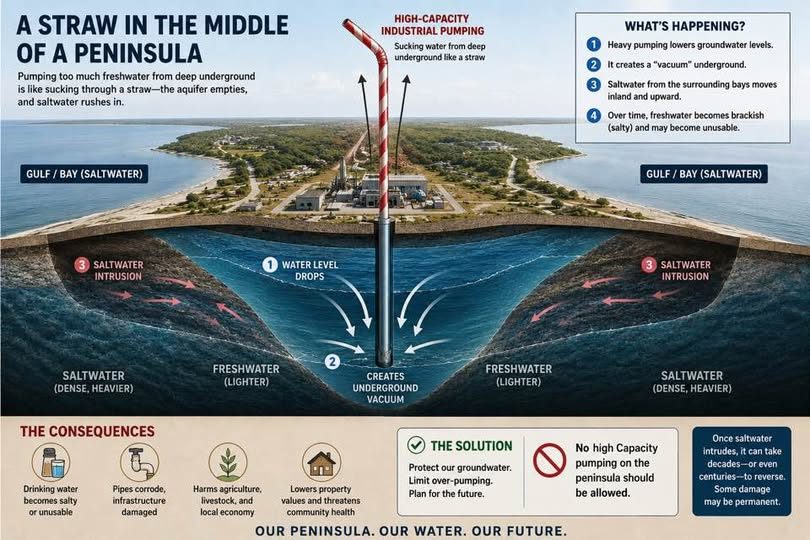
A peninsula is not the place for high-capacity groundwater pumping.
Imagine putting a straw in the middle of a peninsula and sucking as hard as possible. That’s the concern many people have when large industrial users propose pumping millions of gallons of groundwater from an area surrounded by saltwater.
As freshwater levels drop, saltwater can move inland into the aquifer. Once that happens, there may be no quick fix. The damage can last for generations.
Freshwater is our community’s lifeline. It supports our homes, local businesses, agriculture, wildlife, and the bays that make this place special. We have one aquifer—but no backup aquifer.
Before any project is allowed to put that resource at risk, the public deserves clear answers, independent science, and proof that our water can be protected.
No high-capacity groundwater pumping should be allowed on a peninsula where saltwater intrusion could permanently threaten our water supply.
Protect our peninsula. Protect our water. Protect our future.
Did you know? The proposed “Green” Ammonia Plant plans to use 2 million gallons of water per day—roughly 2 times more water than a typical data center. 2 million gallons could meet the daily water needs of roughly an entire county the size of Calhoun County, which has a population of about 20,000 people.
Calhoun County is fortunate to have a Groundwater Conservation District whose mission is to protect our groundwater and aquifers for current and future generations. The District’s temporary permitting moratorium provides time to review and strengthen its groundwater rules so they reflect today’s challenges and help ensure our water resources are managed responsibly as development pressures increase.
Protecting our water isn’t about stopping growth—it’s about making sure growth is sustainable. Our community deserves decisions based on sound science, responsible planning, and the long-term interests of Calhoun County and the people who call it home.
So how much water will really be used each day and how much will be discharged into the bay?
2 MGD. = 800,000 gallons/day discharge
One more huge reason to say NO to the proposed “green” ammonia plant!
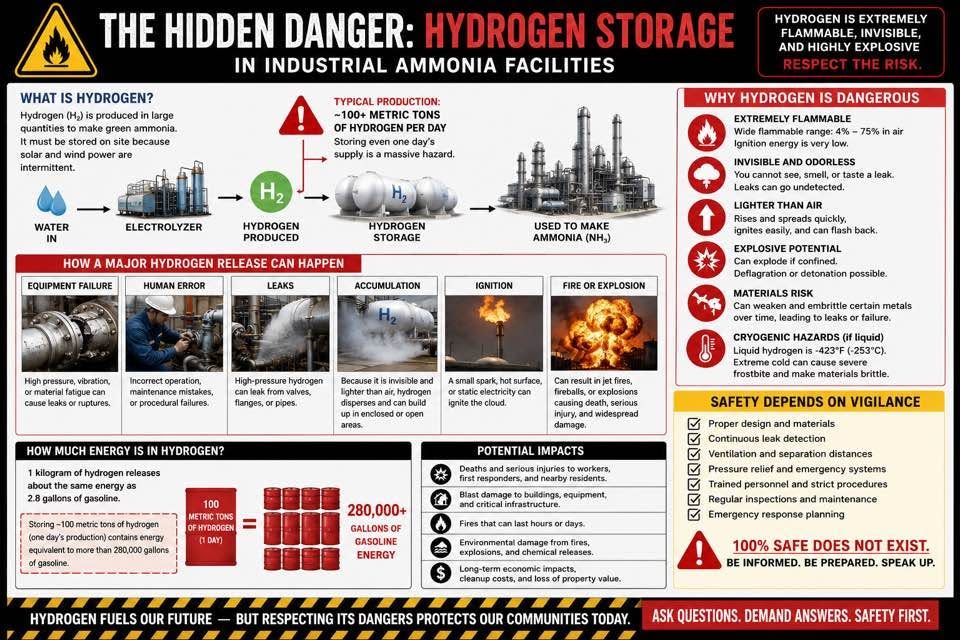
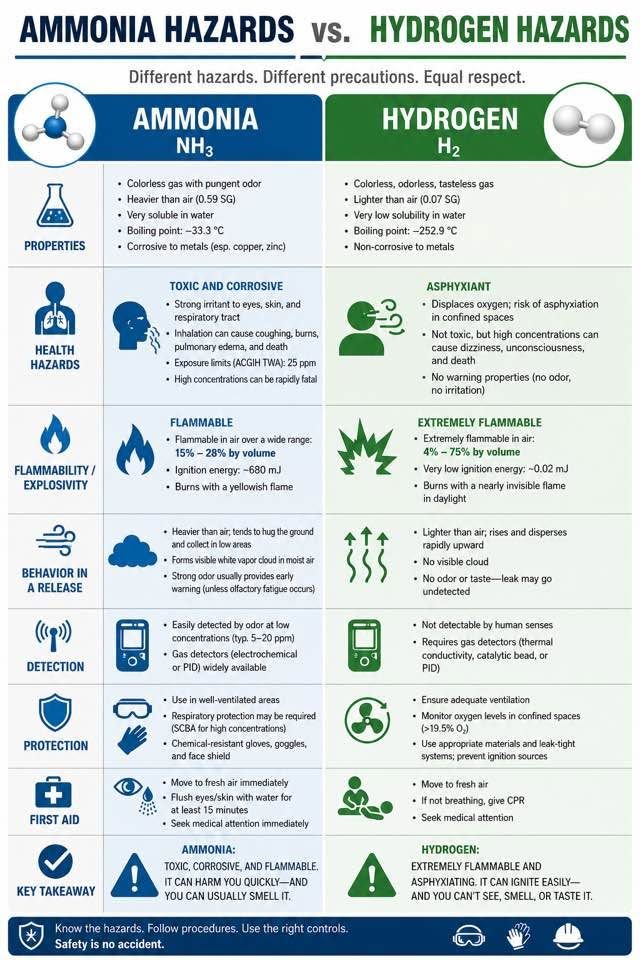
A green ammonia facility does not only involve ammonia. The process also involves producing and handling hydrogen on-site, which introduces another significant industrial safety consideration.
Hydrogen is a highly combustible gas. When mixed with air in the right concentration, it can ignite rapidly from a small ignition source.
Why hydrogen incidents can escalate quickly
* Extremely small molecules: Hydrogen can leak through very small openings.
* Wide flammability range: Hydrogen can burn or explode across a broad concentration range in air.
* Low ignition energy: A small spark, static discharge, or hot surface can ignite a hydrogen-air mixture.
* Invisible flame: Hydrogen flames can be difficult to see in daylight.
* High-pressure storage: Many systems store hydrogen under very high pressure, creating additional mechanical hazards.
Industrial plants like this should never be allowed near residential areas, schools, churches, public gathering places or ranches. The risks are much too high. There should be safety focused building setbacks in place for risk mitigation.
The question we have is: What is the modeled danger zone for the maximum credible hydrogen fire/explosion and ammonia release, and how far are nearby residents from that zone?